How to Remove Skin Tags and Warts Naturally and Cheaply at Home

If you have skin tags, especially larger ones, you probably know how annoying it can be when they are rubbed with clothing, jewelry or when shaving. Although they don’t require treatment, they can still cause irritation or discomfort, and might be not very aesthetically pleasing. Apparently skin tags are common, and according to the NIH (National Institutes of Health) USA, approximately 46% of people have skin tags.
You can go to a dermatologist that can cut off the skin tag, tie it off, burn it or freeze it. What I’m going to talk about today is how to remove skin tags at home using apple cider vinegar (ACV).
An important note is that before you attempt to remove skin growth at home, you need to know that you are removing skin tags – which is a benign condition – and not a mole or any other lesion that can be malignant. Therefore what you are trying to remove should have been previously diagnosed by a health professional as a harmless skin tag.

What are skin tags?

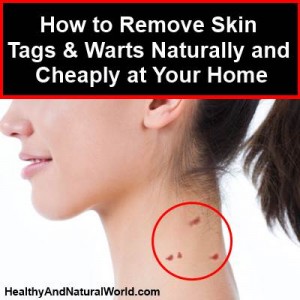
Having skin tags is a benign condition known also by the name acrochordon, and generally occur after mid-life. A skin tag looks like a small piece of soft hanging skin that may hang from a stalk. Skin tags can appear on any part of the body, but are more common in body folds where skin rubs against skin, such as armpits, groin, under the breast, eyelids and neck.
There are several factors that increase the likelihood of having skin tags. Genetics is one of them, while other factors include obesity and people who suffer from diabetes. Also skin tags are more common among pregnant women due to hormonal changes.

How to use ACV to remove skin tags?

ACV has many uses as a home remedy and I’ve mentioned several of them in my previous article 10 Uses for Apple Cider Vinegar for Great Health and At Home. One of its uses is the removal of skin tags due to its high acidity. Don’t use ACV to remove skin tags around the eyelids, as it can harm the eyes.
Wash the area around the skin tag using water and a mild soap and then dry it. Dip a small piece of a cotton ball in ACV and squeeze out the excess ACV. Place the cotton ball with the ACV on the skin tag holding it with a bandage and leave in place for up to 15 minutes. Do it 3 times a day for several days or even a week or more if needed until the skin darkens, dries and falls off.

Warts

A similar way is used to remove warts. Warts are caused by viruses, especially HPV type (human papilloma virus) that causes an infection. The virus causes the top layer of the skin to grow too fast, and the result is a small solid growth with a rough surface that typically appears on the hands or feet. Warts are more likely to develop on broken skin, as the virus can enter the top layer of the skin through scratches or cuts. If you are not sure and wonder whether it may be something else, go and see your doctor to have it checked.
The virus that causes warts can be passed on by skin-to-skin contact or through contact with towels or shoes, and can be spread to other body parts. This is why it is best to treat warts as soon as they appear.
You can use over-the-counter products to treat warts, or visit a dermatologist that can perform wart treatment and removal techniques that are stronger and usually faster than the commercially available products. But you can also easily and safely use ACV.

How to use ACV to remove warts?

Gently clean the wart and the area around the wart. Take a small cotton ball that will cover the wart, and soak it in ACV. Secure with a band aid overnight. Change the cotton ball daily and keep it on every night. After one week, the wart will start to peel off until it is completely removed. You may want to continue this treatment for another few days after the wart has been removed just to make sure it doesn’t return.


Top Signs Your Body is Toxic and What to Do About It

Hundreds of years ago people didn’t have to worry about toxicity in the body. They used a simplistic and natural way of life that didn’t require detoxification of toxins. It wasn’t until just recently that medical professionals began to acknowledge the issue of chemicals polluting our bodies.
We all know the saying “You are what you eat…” But how can we be sure what we are if we don’t know much about what we eat? Nourishing yourself with seemingly everyday foods seems like a perfectly safe venture right?
t turns out that toxins have become an inescapable part of our everyday lives. In the previous decade there have been roughly 100,000 different chemicals used in the United States. They’re used commercially in the food we eat, the medicine we take, and general house care products that appear completely innocent.
Studies by the Environmental Working Group recently discovered that even unborn babies can’t avoid pollution in our toxin-laden society. They found traces of more than 200 commercial chemicals within the umbilical cords before birth. You might not be able to avoid the toxins but knowing where they come from and how to treat them will help reduce the impact of toxicity significantly.

Signs that You Have Too Many Toxins in Your Body

So at this point we know how prevalent toxins are in our society. What we haven’t covered is how to tell whether or not the amount of toxins is effecting your overall health in a negative way. Listed below are a few of the most common signs of too much toxin exposure.
  • Sleep disorders like insomnia and restlessness
  • Body odor and foul breath
  • Persisting exhaustion
  • Worsening inflammatory problems like arthritis and asthma
  • Trouble with digestion
  • Development of ulcers or hemorrhoids
  • Increase in acne, psoriasis, eczema, and other skin conditions
  • Loss of mental clarity and motivation
  • Muscle and joint pain
  • Worsened PMS symptoms
  • Congestion
It’s worth noting that these signs are quite general. Some might be a symptom of a completely irrelevant medical condition. Before you go assuming that your body is polluted you should always check up with your physician.
This is a factor that goes both ways however. Some physicians might have trouble assigning a source to symptoms caused by body toxicity. They may also attribute the symptoms to something that isn’t actually affecting you. This pitfall exists because many medical practitioners aren’t required to be well-versed in body toxicity knowledge.
There are also many diseases that can be worsened with body toxicity. Parkinson’s, Alzheimer’s, depression, cancer, fibromyalgia, and heart disease are all catalyzed with the introduction of toxins.
It’s always better to be safe than sorry and take steps to enhance detoxification. The strongest weapon in the fight against body toxicity is knowledge. Reducing your exposure to toxins and practicing detoxification can only encourage a healthier and happier lifestyle.

Major Sources of Toxins

The first toxin source you should be weary of is food. This plays a huge role in detoxing your body because it is the most direct intake of industrial chemicals. Processed foods are the most common source of additives and chemicals and should be avoided when possible. Pesticides sprinkled on to crops can also add foreign toxins to your body. You can also read my other post about the most pesticide ridden fruit and vegetables.
Another deceiving source of toxins is within personal care products. Chemicals are abundant in a lot of the shampoo, body wash, soap, lotion, toothpaste, skin cream, and deodorant that we use so casually on a daily basis. If you want to avoid these toxins you can make your own natural healthcare products.
The third major contributor of toxin intake is environmental factors. Inside of your home there could be chemicals lingering from the use of cleaning products and a lack of air circulation. Outside of your home there are plenty of pollutants from secondhand smoke, vehicles, and the production of commercial goods. You can read my other post on how to make your own natural household cleaner.
Keep in mind that these are just the three major contributors to toxicity within your body. There are plenty of other small ways that toxins can sneak into your routine. Always exercise caution when purchasing products and carefully examine the areas that you live in.

Easy Steps for Optimal Detoxification

1. Reduce Exposure – The first and most obvious step to take is modifying your routine to reduce your exposure to the chemicals. Analyze the sources listed above and try to minimize the pollution you encounter throughout the day. You can start by avoiding these most toxic food ingredients and avoiding these fake foods.
2. Stay Hydrated – Water is an essential tool for your body to flush out the chemicals you are exposed to. Purchase a filter to make sure your water is pure and make sure you drink it in regular intervals. A minimum of 8-10 cups of water per day is recommended.
3. Go Organic – Switch up that shopping list and ditch the processed foods. Look for organic sources of fruit and vegetables and try to avoid retailers that mass produce it. This will decrease the presence of chemical fertilizers and pesticides that are used for commercial gain. Green vegetables and most fruits have effective detoxifying qualities. You can find more information in my article about how to detoxify your body using chlorophyll and how to detox your body with these 8 leafy greens.
4. Maintain Healthy Digestion – Get the right amount of fiber in your diet and make sure that you use the bathroom regularly. The average person should move their bowels 1-2 times each day to prevent toxin buildup. You can make you owndigestive detox smoothie.
5. Exercise – Getting active will fire up your circulation and turn your body into a toxin flushing machine. Going for runs, swimming, playing sports, or simply getting out to walk around once in a while will help keep you in shape and away from body toxicity.
6. Supplementation – There are health supplements out there that will help you reduce toxicity within your body. For example: spirulina and chlorella are two kinds of blue-green algae that are effective at binding and removing toxins from your body, and they work well for detoxing from heavy metal exposure. You can get more information in my article on how to boost your health by eating seaweeds and algae. If you have been exposed to a large amount of toxins and want a quick fix, some recommend taking activated charcoal. Always check with your doctor before taking any supplements.
You can a lot more information about the most effective natural methods to detox your body in my e-book The Detox Guide. This guide will teach you how to use detox to cleanse and energize your body naturally and safely.
Many people are shocked to learn that the environment isn’t the only thing we’re polluting. Our own bodies suffer as well. With these steps in mind you can lead a lifestyle free of body toxicity. You’ll feel better and ensure a healthier future once you’ve taken the step towards a natural life and cleared your body of toxins.

6 THINGS YOU MISSED THIS WEEK FROM HEALTH.COM


Facebook has been very exciting for us this week after hitting 1 MILLION followers! We are so happy and thankful to have you all on board with us and really appreciate the sense of community and love you give to our page. Thanks, friends!

To top it off, we also had a super fun Facebook chat with contributing nutrition editor Cynthia Sass, MPH, RD, and got to see the ins and outs of being a nutritionist. One follower asked about Cynthia’s favorite food fact (answer below), and it definitely surprised us (three cheers for chocolate!). Check out Cynthia’s Facebook chat.

Aside from battling through a CYC Fitness class, celebrating World Nutella Day, and building snowmen, we also launched a Super Bowl Fitness Challenge to keep Instagrammers active during the big game. Didn’t participate? That’s OK—we think you could do this workout during plenty of sporting events. (How about a push-up for every time Team USA gets on the medal stand at the 2014 Winter Olympics?)


Spot The Millionaire

The wounded warriors are a legacy of war, something that has stayed with him from two White House terms that started with a focus on domestic policy but took a sharp turn once terrorists struck the United States on Sept. 11, 2001.
“He realizes what it cost some of the guys,” said Cliff Johnson, a friend and former gubernatorial aide. “Bush got emotionally committed and involved in their suffering. I think it’s affected him deeply.”
Bush ran for president in 2000 talking about education, tax cuts and humility in foreign policy, and his first eight months in office, those were the focus. But it wasn’t just his administration and its policies that were different after 9/11, colleagues say. Bush himself was altered when the twin towers fell.
“He was focused before, but with 9/11 that focus became more intense and laserlike with everything,” said Joe Allbaugh, his former chief of staff as governor and director of the Federal Emergency Management Agency when Bush was in the White House.
“For myself, I can say it made me more serious. And I viewed him much the same way,” said Allbaugh. “It was a day that sears not just the mind, but the heart, and you never get away from it.”
Karen Hughes, a longtime Bush aide in Austin and counselor to the president, said the fall of 2001 was shaping up for more work on Bush’s domestic agenda.
“We were working on No Child Left Behind, we were working on the economy, we had passed the tax cuts. Congress was getting ready to come back for the fall, and most of the outlook was domestic policy,” she said.
“Obviously, as of that morning, the entire focus changed.”
The transformation to a wartime presidency presented Bush with an overriding purpose, however unwanted, that would redefine the man and his legacy. And it led him into areas that marred the public’s view of him when he left office, including the Iraq war, surveillance policies that many felt went beyond the bounds of the Constitution and a tough approach to the world that soured even some U.S. allies.
Bush is famously reluctant to reveal himself, and his memoir, Decision Points, largely avoids introspection. His book is mostly a vigorous telling of events and a defense of his decisions. In the days after 9/11, he felt it was important for the country to see a president who was steady, confident and in charge, he says.
“My West Texas optimism helped me project confidence,” he writes. “Occasionally, I spoke a little too bluntly, such as when I said I wanted bin Laden ‘dead or alive.’ The people around me helped a lot during those trying days.”
The terrorist attacks were a cataclysmic event in which no one was left unchanged and the fear of more attacks, the rapid escalation of a military campaign and the installation of cumbrous security procedures at airports were all reminders of a nation at war.
In his book, Bush says he could not sleep. He says he saw images of the towers falling, frightened faces and people jumping to their death. When he first visited Ground Zero on Sept. 14, he saw the colossal rubble and raw emotions.
“The blood lust was palpable and understandable,” he writes.
Afterward, Bush drove three miles north to the Javits Center, a staging area for first responders and a gathering place for about 200 family members of missing firefighters and police officers.
Hughes remembers the scene. “We walked into the waiting room, and it was so intense, I couldn’t stand it,” she said. “I literally could not stand it. It was so awful. I felt I had to leave, the grief and pain and the loss was just overwhelming.”
When she returned 30 minutes later, she saw Bush move from family to family, listening to their stories, looking at pictures and commiserating. Allbaugh, who was there at Ground Zero with Bush, said it was impossible not to be deeply affected by the day.
“I can still close my eyes and smell, as he did that Friday on the first visit, the odor, the stench, the poison in the air and see literally the fear in people’s faces,” said Allbaugh. “When you have the responsibility of the presidency and of the United States, that weighs heavily on your shoulders. And what I noticed as a personal change was that his hair turned grayer faster right after that.”
The decisions after 9/11 remain controversial: First, Afghanistan and then regime change in Iraq, the use of interrogation techniques such as waterboarding, the establishment of a prison for terror suspects at Guantánamo Bay. Civil liberties collided with public safety — eavesdropping on conversations abroad, implementation of swollen airport security at home.
Much of it has endured under Barack Obama. Despite his campaign promises to close Guantánamo and recall the troops, America remains very much at war against terrorism. It appears the U.S. may have a permanent military footprint, albeit it small, in Iraq.
In his presidential library at Southern Methodist University, Bush will answer critics who say America went to war on false information and bungled the outcome, squandering thousands of lives and billions of dollars. At his library, allies say, Bush can point to the ferment leading to the Arab Spring as evidence that his freedom agenda began to transform a troubled part of the world.
Last spring, Bush and his wife, Laura, were at dinner at a restaurant in Dallas when the Secret Service told him the White House had called. He returned home and Obama gave him the news: Osama bin Laden was dead.
“I didn’t … feel any great sense of happiness or jubilation,” Bush said in an interview broadcast on the National Geographic Channel. “I felt a sense of closure. And I felt a sense of gratitude that justice had been done.”
In his public appearances, he exudes the certitude of a man reconciled in the belief that he did his best amid tumultuous circumstances. Privately, friends say, in his often unannounced visits to military hospitals, he is a man deeply affected by the events of 9/11 and its aftermath.
“As much as you want to go on,” said Allbaugh, “there is a part of you that is frozen in time on Sept. 11 — and forever will be frozen in time.”
It’s true for the man who was president. In his final White House address to the nation in 2009, Bush said, “Most Americans were able to return to life much as it had been before 9/11.”
Then he added: “I never did.”

WTF Japan!?

Effects that delivers anesthesia , depending on the type of the patient's body , however, many risks are minimized , given that this area , like others in medicine , are well advanced . However , they exist .
It is important to realized preanestetike phase , to understand the patient's condition . Wrong is the idea that anesthesia can bring headaches after the fact is not so. The only case that exception , anesthesia is performed on the spine . However , not all patients respond equally well after this phase .

If the headache starts , it never lasts more than a day or two . According to doctors , this head pain can be avoided by consuming mass fluids or medications , but the latter should always be consulted by a doctor , to avoid any possible reaction .

If that happened in another moment , the previous surgery , a patient has reacted badly by anesthesia or anesthesia , it does not mean that it will happen at a later time , after changing the human body . However, the good doctor is informed about this fact to show caring to add this feature to your situation before you make anesthesia .

Young children , or those who are breastfeeding , can very well afford anesthesia , perhaps even more easily than adults . If that happened in another moment , the previous surgery , a patient has reacted badly by anesthesia or anesthesia , it does not mean that it will happen at a later time .

Facts About The United Kingdom

Location: The United Kingdom (UK) is located to the north-west of continental Europe. The UK is made up of the island of Great Britain (including England, Scotland and Wales), and part of the island of Ireland – the area called Northern Ireland. Northern Ireland has a border with the Republic of Ireland, but apart from this, the rest of the UK is surrounded by water (the Atlantic Ocean, the North Sea, the Irish Sea and the English Channel.Often called the Union Jack or Union Flag, the flag of the United Kingdom combines the flags of the the patron saints of England, Ireland and Scotland -the red cross of Saint George, the Cross of St Patrick and the St Andrew’s Cross (the Saltire). Wales is not represented in the flag because when the flag design was put together, Wales was part of England.

The story begins

 MAKEUP...

Click on the photo to ZOOM it.

The story begins a winter afternoon , when my daughter in fourth grade , the school " Edith Durham " , in the center of Tirana , was an ambiguity in the case of the Albanian language and seeks help for a story that was there . Before it clear to my daughter should read the story . Read the story and was more occupied as a current .

George and Jon , two classmates by sharing photos of national players during the break between . Joni George buys a picture from 1000 of ALL . Joni who wins the money will buy a bike , but also needs much more, because costing much more than that. In coming to help us ATG , which advises that this money be put into a bank and open an account , as it has done itself some time ago.

Up here , the story except artistic mediocrity , as is written in dialogue form , and I can talk a lot , who does not know anything -